Georgina Hayden

Feeding since 1982

  • Recipes
    • Breakfast & brunch
    • Starters & sides
    • Light meals
    • Main meals
    • Snacks
    • Baking & puddings
    • Drinks
    • Preserving
    • Travel
    • Reviews
  • Books
    • Greekish
    • Nistisima
    • Taverna
    • Stirring Slowly
  • Styling
  • About
  • Contact
  • Press

Dukkah egg and avo hash

01.16.2015 by georgie // Leave a Comment

What an intro to 2015! There have been lurgies, house hunts, port binges and last week I started back at work part-time. Its been lovely to see friendly faces, and even though it’s a bit scary/ daunting at times, I’m enjoying the routine and sociability of it. I just don’t know how I used to get anything done though! So today I stripped it back, went to the gym and made myself some nice food. Super simple day. It feels good to have time at home again and time to breathe.

I’ve genuinely missed my ‘lunches for one’ over Christmas and New Year. I feel like I’ve nourished myself over the last few months, and taken time out to make myself strong again. It feels like a crucial part of my journey, so it’s been good to get back in the kitchen.

Today for lunch I made myself a bang on trend brunch dish (eggs and dukkah) but with a more substantial base. If you ever come to stay at our house chances are I will make you a hash at some point. I love it. Anything goes and its one of our favourite weeknight dinners. And as a very wise person once told me ‘there is no meal that can’t be improved with an egg on top’ and I actually think they’re right.


Dukkah egg and avo hash
Not the most perfect egg but tasted darn good!


DUKKAH EGG AND AVO HASH

Serves 1 (multiply as needed! Simple as that)

  • 350g potatoes (I like to use half maris piper and half sweet potato for a lighter dish)
  • Olive oil
  • Sea salt and freshly ground black pepper
  • A few sprigs of coriander, leaves picked
  • 1/2 a small onion (or 1/4 of a normal one) red or white, peeled
  • Red wine vinegar
  • 1/2 tablespoon runny honey
  • 1/2 a ripe avocado, sliced
  • 1 large egg, free range or organic
  • 1/2 teaspoon dukkah, homemade or store bought – see below
  • Squeeze of lemon juice

Start by giving you potatoes a good scrub (I leave the skins on for added nutrients and texture) and then cut into even sized chunks. Place in a pan of boiling salted water and boil for around 8 – 10 minutes, depending on the size of your pieces, until cooked through.

Whilst the potato is cooking slice the onion as finely as you can and place in a bowl. Cover with a good splash of red wine vinegar and the honey. Give it all a good stir, making sure the onion is covered in the vinegar mix and leave to one side.

When the potato is cooked drain completely and mash the potatoes in the pan (I like to keep the hash a little chunky so mash the veg enough to break them down but not completely smooth). Add most of the coriander leaves, season well and poor a lug of oil into the bottom of the pan and place it back on a medium heat. Fry the the hash for around 8 – 10 minutes, mixing it up and flipping it over now and then, till it is golden and crisp, with lovely crunchy bits throughout.

Half way through frying the hash, place a small pan of water onto boil and poach the egg to your liking – I do mine for 2.5 minutes for a runny yolk.

Plate up! Spoon the hash onto a plate, scatter over the lightly pickled onions (leaving the vinegar behind) and top with the sliced avocado. Squeeze over a little lemon juice, and finish with the poached egg and sprinkled dukkah (and an extra pinch of salt and pepper). Scatter over any remaining coriander leaves and tuck in.


EGYPTIAN DUKKAH

You’ll find dukkah in the spice aisle of most supermarkets now. However if you struggle to get hold of it, or just fancy making your own, it’s dead easy to make. It lasts ages and is fantastic sprinkled on almost anything, especially eggs.

  • 100g sesame seeds
  • 100g blanched almonds or hazelnuts (or a mix)
  • 2 tablespoons coriander seeds
  • 2 tablespoons cumin seeds
  • 1 teaspoon fennel seeds 
  • 1 heaped teaspoon sea salt
  • 1 tablespoon freshly ground black pepper

Preheat your oven to 180. Spread the nuts out in a tray and roast in the oven for around 4 minutes, until lightly golden. Pour onto a plate or into a bowl and leave to one side to cool.

Toast the sesame seeds into a dry frying pan until golden and again, spoon into a bowl, and leave to cool. Toast the cumin, coriander and fennel seeds for a minute or so until they start to smell wonderful and remove from the heat. Once all the nuts and seeds have cooled either grind them in a pestle and mortar, or blitz in a food processor with the salt and pepper until you have a coarse blend. Et voila! Homemade dukkah.

Categories // Breakfast & brunch, Light meals, Main meals, Vegan and Vegetarian Tags // Avocado, Breakfast, Dairy-free, Dukkah, Egg, Fertility, Gluten-free, Mains, Nutrition, Potato, Pregnancy, Vegetarian, Wheat-free

Sweet potato layer cake with ginger frosting

01.08.2015 by georgie // 2 Comments

As much as I’m a little bit glad the festive season is over, I’m not quite ready to let go of all the festive flavours just yet. I love anything laden with spice: cinnamon, ginger, cardamom… and it’s the perfect time of year to eat them. With that in mind I decided to have a little play with a slightly lighter, more interesting spiced sponge – and because, lets be honest, the world and their dog are on diets at the moment so if you can shove a vegetable in a cake it’s healthy, right?

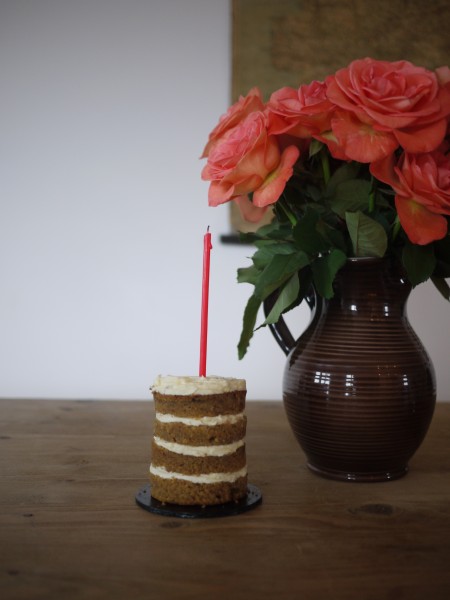
It was my dear friend Laura’s birthday this week, so unfortunately she ended up being my guinea pig. I say unfortunately, but actually I think this cutie went down rather well! My new favourite vegetable cake, it’s really rather nice.

Sweet potato layer cake with ginger and chocolate frosting

SWEET POTATO LAYER CAKE WITH GINGER FROSTING

Serves 12

  • 280g plain flour
  • 2 heaped teaspoons ground cinnamon
  • 1 teaspoon ground ginger
  • 2 teaspoons baking powder
  • 1 teaspoon bicarbonate of soda
  • pinch of salt
  • 150g butter, at room temperature
  • 150g soft light brown sugar
  • 1 teaspoon vanilla extract
  • 3 large eggs, free range or organic
  • 260g pureed sweet potato*
  • 100g natural yoghurt
  • A little spiced rum, for brushing

Frosting

  • 150g butter, at room temperature
  • 400g icing sugar, sifted
  • 150g cream cheese
  • 1 tablespoon finely chopped stem ginger
  • 75 melted dark chocolate (optional)

Preheat the oven to 180. Grease and line the base of 2 x 6″ spring form cake tins.

Sift together the flour, ground cinnamon and ginger, baking powder, bicarbonate of soda and salt into a bowl. In a separate bowl mix together the sweet potato puree and yoghurt.

Using a freestanding mixer, or electric hand mixer, cream together the butter and sugar until pale and fluffy. Stop occasionally to scrape the mixture off of the side of the bowl with a spatula. Add the vanilla to the butter and cream the eggs in one by one. Add the dry ingredients and slowly mix in, until just combined, don’t over work it. Fold in the sweet potato and yoghurt mixture then divide evenly between the two tins. Bake on the middle shelf of your oven for around 35 minutes until cooked through. Leave the sponges to cool in the tins for 5 minutes and then transfer to a cooling rack to cool completely.

Whilst the cakes are cooling make your frosting. Clean your freestanding/ electric mixer and cream the butter until pale and light. Drain any excess liquid from the cream cheese and beat into the butter, only just enough to mix the two together – too much and it becomes runny. Beat half the sifted icing sugar into the mix, and when fully combine beat in the remaining half. When its smooth beat in the chopped stem ginger, with a little of the syrup from the jar and leave to one side. If your frosting has become a little runny, pop in a bowl in the fridge for 30 minutes to firm up. If you want to use the chocolate (and it is delicious) swirl the cool but melted chocolate into the frosting and mix together. I keep mine a little rippled so that it has an interesting pattern when I frost the cake.

How you decorate your cake it up to you! Just remember to brush the sponges with a little spiced rum as you go. You can keep it as two cakes, frost them together and coat. Cut the sponges with a round biscuit cutter and make mini layer cakes (I cut rounds from the large cakes, and then slice those in half horizontally to make 4 layer mini cakes – see below). Or slice to two large cakes in half horizontally and create an open sided layer cake. The choice is yours.

* To make the sweet potato puree I peeled a couple of sweet potatoes, cut them into chunks and boiled them until cooked through. Drain and leave to cool and then blitz in a blender with just enough water to puree.


Naked cake
Naked cake


Categories // Baking & puddings, Cake decorating, Celebration, Vegan and Vegetarian Tags // Baking, Birthday, Cake, Christmas, Ginger, Sweet Potato, Sweets, Vegetarian

My ‘go to’ South Indian dal recipe

01.05.2015 by georgie // 10 Comments

When I published my dal makhani recipe a month or so ago a friend said she loved the sound of it but didn’t have the time to make it (it does take several hours), and do I have any other dal recipes that are quicker? Well, I love nothing more than a request, and of course! I’m just ashamed it’s taken me so long to upload to be honest (I blame the madness of Christmas and New Year).

So, my ‘go to’ South Indian dal. It isn’t strictly authentic, but it is based on several trips to South Indian and eating lots of dal laden with mustard seeds, curry leaves and coconut. This is a real store cupboard comfort food recipe for me; I always have yellow split peas in the cupboard, (it covers so many cuisines – Greek Fava, Swedish soup, Pease pudding, Indian dal…), low fat coconut milk is a key dry store staple for me and my biggest tip? Buy a big bag of curry leaves when you find them and pop them in the freezer. They freeze well and it means they’re always on hand. (You’ll find them in any Indian supermarket or sometimes online. You can use dry if you have them but they’re not as punchy and don’t fry as well).

It might not look like much but this dal is incredibly comforting and really is delicious. It is wholesome, filling and packed with iron and it freezes wonderfully, so perfect for a rainy day. Sarah, I hope you like it!

South Indian dal
South Indian dal


MY ‘GO TO’ SOUTH INDIAN DAL

Serves 4 – 6 (serve it as is for a filling and hearty soup or with basmati rice as a meal)

  • 300g yellow split peas, soaked for 20-30 minutes before cooking
  • Groundnut oil or coconut oil
  • 2 onions, peeled and finely chopped
  • 4 cloves of garlic, finely sliced
  • a thumb sized piece of ginger, peeled and finely chopped
  • 1 teaspoon turmeric
  • 1 heaped teaspoon ground cumin
  • 1 heaped teaspoon heaped ground coriander
  • 1/2 teaspoon ground cinnamon
  • 1 tin of low fat coconut milk
  • 20 curry leaves
  • 1 teaspoon black mustard seeds
  • 1 green chilli, deseeded and finely sliced
  • Half a lemon
  • Sea salt and freshly ground black pepper

Pour a lug of groundnut or coconut oil into a large non-stick saucepan and place on a medium low heat. Add the onion, ginger, most of the garlic and saute the veg for 10 minutes until softened but not coloured. Add the turmeric, cumin, coriander and cinnamon and fry for a further 2- 3 minutes.

Drain the yellow split peas, rinse and add to the pan along with the can of coconut milk. Add 600ml of water to the pan, or more, ensure that the split peas are completely covered. Gently bring to the boil and then lower to a simmer and cover the pan. Cook over a low heat for around 1 hour and 15 – 20 mins, so that the split peas have completely cooked through and have turned to mush. Check the dal every so often during cooking, and top up the water if it feels like it is getting too thick. You’ll probably need to add a splash here and then. Squeeze in the lemon juice, season to taste and leave to one side.

EDIT/ NB: Someone just asked me on Instagram if I pureed my dal, as it looks so smooth, which I didn’t. But having said that I did use yellow split peas I bought in Greece which become very creamy. If your peas haven’t completely broken down then do try pureeing them with a hand/ stick blender for a smooth finish.

Add a few tablespoons of groundnut or coconut oil to a small frying pan and place on a medium heat. After a minute or so add the mustard seeds and fry for around 30 secs – 1 minute until the seeds start to pop. Once they do add the garlic, curry leaves and chilli and fry everything for a few minutes, until the garlic and chilli are golden and the leaves look translucent.

Check your dal, as it will probably have thickened a little as it cools, so add a splash of boiling water if it feels too thick. Serve the dal in bowls, and drizzle a little of the temper over the dal- the flavoured oil and leaves, chilli and mustard seeds.

TIPS:

  • l love this recipe with spinach added at the end of cooking. Stir in a handful of frozen spinach balls for the last 5 – 10 minutes of cooking, or a large bag of baby spinach chopped up for the last few minutes. Great for an added iron boost.
  • I didn’t have any fresh green chillies to add to my temper for the picture above, so I ended up just giving it a drizzle of chilli oil before eating, which is totally acceptable too!

Categories // Light meals, Main meals, Vegan and Vegetarian Tags // Dairy-free, Dal, Gluten-free, India, Mains, Nutrition, Pregnancy, Soup, Starter, Vegan, Vegetarian, Wheat-free

  • « Previous Page
  • 1
  • …
  • 13
  • 14
  • 15
  • 16
  • 17
  • …
  • 26
  • Next Page »
Meet


Georgina is an award winning food writer, cook and presenter from North London.
Read more about Georgina

Recent Posts

  • Book Publication Week – Greekish is here!
  • Introducing “Family Feeds”: A Tasty New Podcast about Food and Family
  • Be More Yiayia T-Shirts are here!
  • Nistisima (And Hello!)
  • My love affair with Delicious

Copyright © 2026 · Modern Studio Pro Theme on Genesis Framework · WordPress · Log in